

Appearance
Video
The video elements play a video on your page. Use the Video element for a video file you upload to your project, or the Youtube, Vimeo, Dailymotion and Twitch elements for a video hosted on these platforms.
All five elements work the same way in workflows. They can start a workflow when the video plays, pauses or ends, and your workflows can play it, pause it or move it to a given time. Use them for a product tour on a landing page, a lesson in an online course, or a tutorial in your app.
Getting started
- Add a video element to your page from
Add Element. You'll find the five elements underMedia. See which element to choose → - Choose your video file, or paste the link to your video. See how to add a video file →
- Set how the video plays: autoplay, sound, loop and controls. See the playback settings →
- Add workflows to react to the video or control it. See how to use workflows →
USING AI
You can also ask AI to add a video. Tell it where the video comes from and how it should play. For example: "Add the YouTube video https://www.youtube.com/watch?v=KenR4vRW_KA below the title, muted and in a loop".
Choose a video element
Element in Add Element | Plays | What you give it |
|---|---|---|
Video | a video file uploaded to your project, or the link to a video file | File |
Youtube | a YouTube video | Video url, for example https://www.youtube.com/watch?v=KenR4vRW_KA or https://youtu.be/KenR4vRW_KA |
Vimeo | a Vimeo video, including unlisted videos | Video url, for example https://vimeo.com/123456789, or https://vimeo.com/123456789/abcdef1234 for an unlisted video |
Dailymotion | a Dailymotion video | Video url, exactly in the form https://www.dailymotion.com/video/x84sh87, without anything after the video ID |
Twitch | a Twitch video or a live channel | Video url, for example https://www.twitch.tv/videos/123456789 for a video, or https://www.twitch.tv/channelname for a channel |
Each element only reads links from its own platform. To play a YouTube video, use the Youtube element, not Video.
Add a video file
The Video element plays a video file that you upload to your project:
- Select the
Videoelement and open its settings - Click on
Choose Videonext toFile - In the
Project fileswindow, click onUpload new fileand choose your video. You can upload.mp4,.avi,.flv,.3gp,.mkv,.mpeg,.ogg,.movand.webmfiles. Just make sure the file size fits within the storage space of your pricing plan. - Click on the name of your file to use it
- To show an image before the video starts, click on
Choose imagenext toPreview image
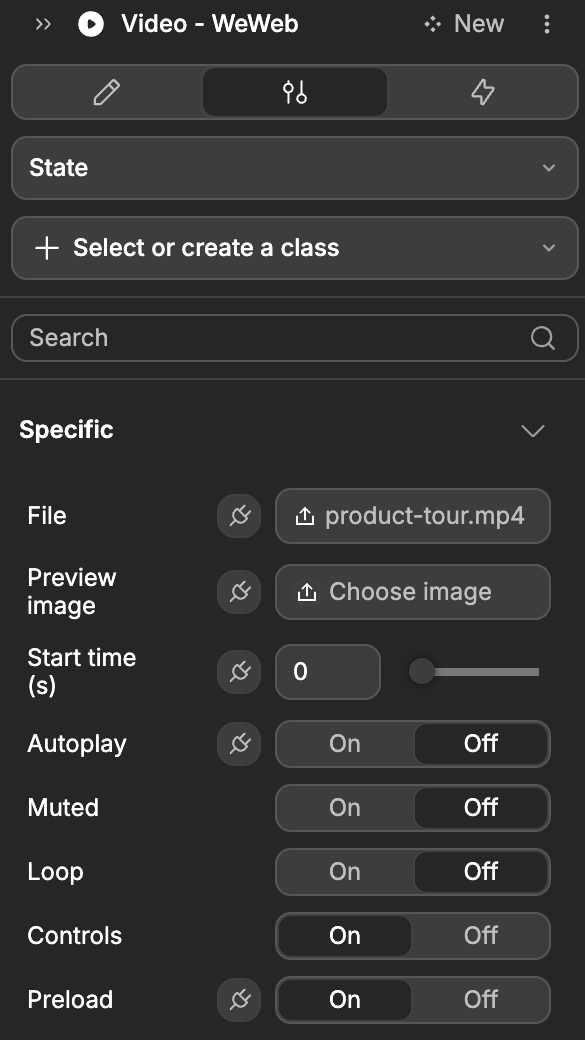
You can also bind File to the link of a video file stored somewhere else, for example a file URL saved in one of your tables.
The video fills the whole element. Set the size of the element in the Style tab, for example a width and a 16:9 ratio, so the video has room to show.
Set how the video plays
These settings apply to the Video, Youtube and Vimeo elements. Dailymotion and Twitch have fewer of them: see the settings of each element.
Start time (s): the second where the video starts. TheVideoelement rounds it up to the next whole secondAutoplay: starts the video as soon as the page loads. When you turn it on,Mutedturns on too: browsers only start a video on their own when it has no soundMuted: starts the video without sound. Users can still turn the sound on with the controlsLoop: starts the video again when it endsControls: shows the play button, the time bar and the volume and full screen buttons. Turn it off if you build your own buttons with workflowsPreload:Videoelement only. Lets the browser load the video before the user plays it
TEST IN PREVIEW
In the editor, the video doesn't start on its own and doesn't run its workflows, so you can work on your page without it playing. Switch to Preview to test Autoplay and your workflows.
Run a workflow when the video plays, pauses or ends
Each video element can start a workflow when the user plays, pauses or finishes the video. For example, show a sign-up form at the end of a product tour, or go to the next lesson when a course video ends.
- Select the video element and open its
Workflowstab - Click on
New, then onElement triggers - Choose
On play,On pauseorOn end - Add the actions of your workflow
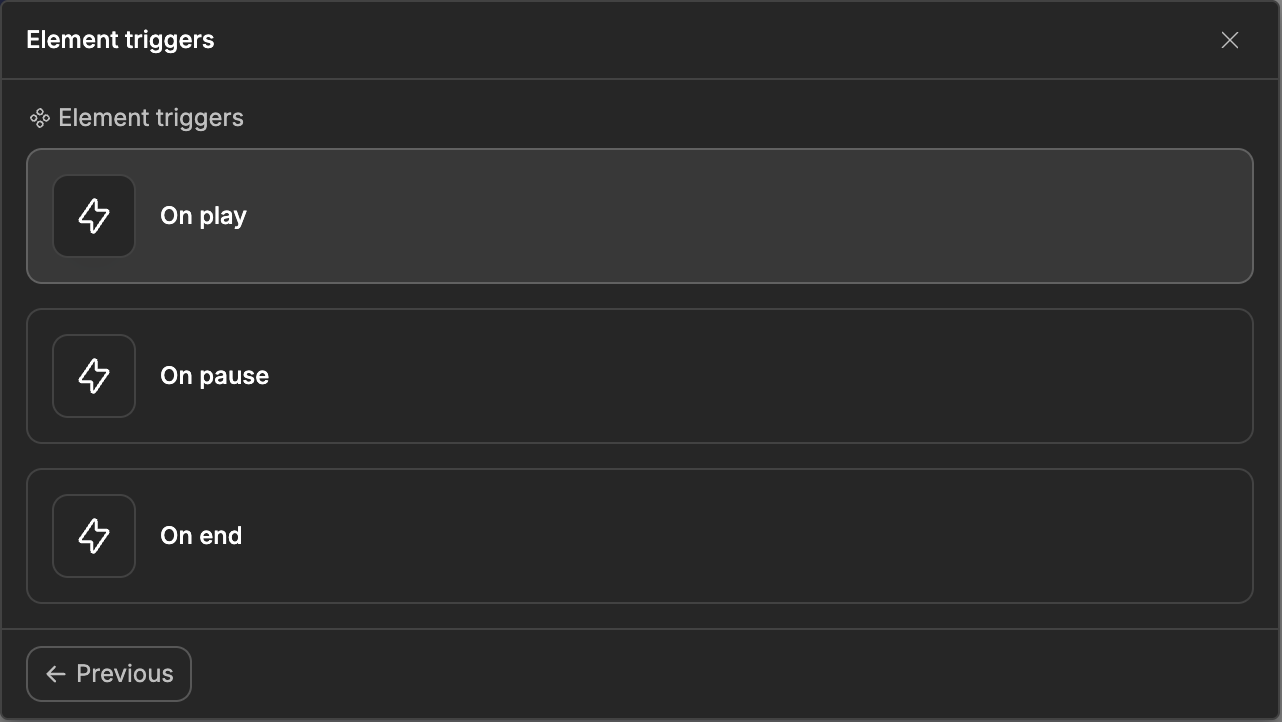
With the Video, Youtube and Vimeo elements, the event sends the time where the video was when it played, paused or ended, in seconds. You'll find it in Event > value. The Dailymotion and Twitch elements send no data with their events.
Control the video from a workflow
Your workflows can play the video, pause it, or move it to a given time. For example, add buttons that jump to each chapter of a tutorial.
To make a Skip to features button that moves the video to its sixth second:
- Select the button and add a workflow
On click - Add the
Execute component workflowaction. You'll find it inInterface>Components - In
Component, choose your video element, then chooseSeek to - Type the time in seconds in
Time, here6
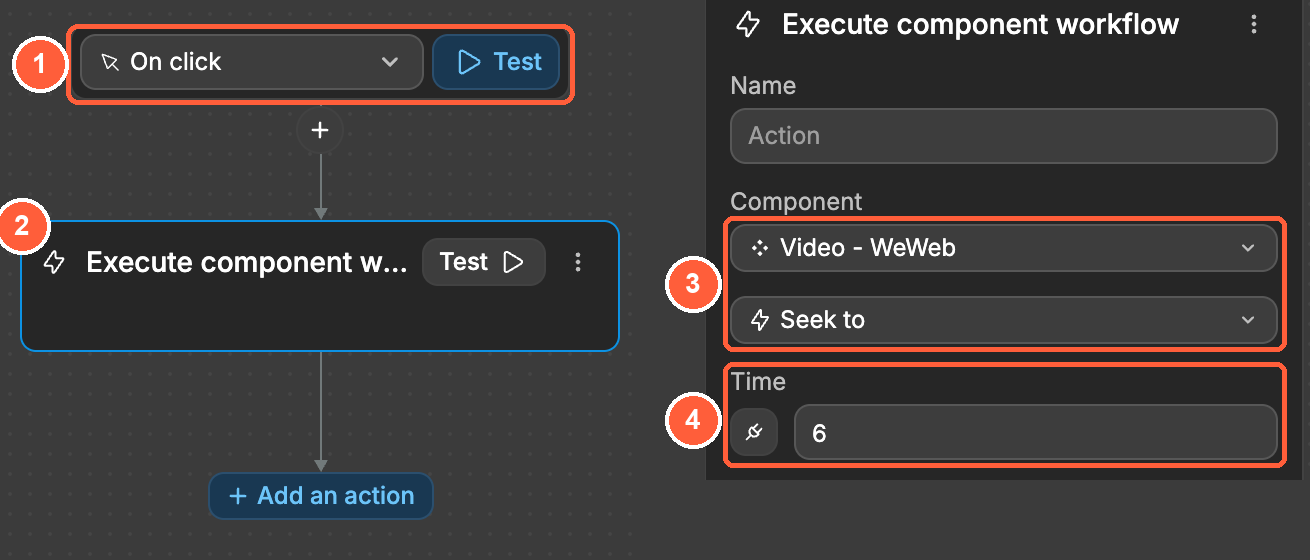
Seek to moves the video but doesn't play it. To play it from there, add a second Execute component workflow action with Play video.
The three actions available on every video element are:
Play video: starts or resumes the videoPause video: pauses the videoSeek to: moves the video to the time set inTime, in seconds
Learn more about the Execute component workflow action →
Show the state of the video
Each video element shares two variables that you can bind anywhere on your page:
Is Playing:truewhile the video plays,falsewhen it's paused or endedCurrent time: where the video is, in seconds
For example, bind the text of a button to Is Playing to show Pause while the video plays and Play when it's paused.
Example use cases
- Product tour: a muted video in a loop at the top of a landing page, with
Autoplayon andControlsoff - Online course: a lesson video that goes to the next lesson
On end - Tutorial with chapters: one button per chapter, each with a
Seek toaction - Custom player:
Controlsoff, and your own play and pause buttons that usePlay video,Pause videoandIs Playing - Live stream: a
Twitchelement set to a channel, to show a live event on your site
Best practices
Do:
- Keep
Mutedon whenAutoplayis on, or the browser won't start the video - Add a
Preview imageto theVideoelement, so the page looks finished before the video loads - Compress your video files before you upload them: smaller files start faster
- Test your workflows and
AutoplayinPreview
Don't:
- Paste a YouTube or Vimeo link in the
Videoelement: use the element of the platform - Turn off
Controlswithout adding your own play and pause buttons - Add extra parameters to a Dailymotion link
Forking
While the video elements offer the settings most pages need, there may be cases where you need functionality beyond what's natively available. In these situations, you can fork an element and modify it to meet your specific requirements.
If you are unsure how to fork an element, you can learn more in the dedicated documentation.
Forking example: playback speed
One reason to fork the Video element would be to let users change the playback speed. To do so, you could fork the element, then edit it with AI and pass in the following prompt:
Add a Playback speed setting with the options 0.5, 1, 1.5 and 2, and a Set speed action that changes the speed from a workflowProperties reference
Settings
Video
| Property | Options/Type | Description |
|---|---|---|
| File | video file | The video to play: a file uploaded to your project, or the link to a video file |
| Preview image | image | The image shown before the video starts |
| Start time (s) | number | The second where the video starts, rounded up to the next whole second. Default: 0 |
| Autoplay | boolean | Starts the video when the page loads. Turning it on also turns on Muted. Default: off |
| Muted | boolean | Starts the video without sound. Default: off |
| Loop | boolean | Starts the video again when it ends. Default: off |
| Controls | boolean | Shows the controls of the player. Default: on |
| Preload | boolean | Lets the browser load the video before it plays. Default: on |
Youtube
| Property | Options/Type | Description |
|---|---|---|
| Video url | text | The link to the YouTube video, in the form https://www.youtube.com/watch?v=... or https://youtu.be/... |
| Start time (s) | number | The second where the video starts. Default: 0 |
| Autoplay | boolean | Starts the video when the page loads. Turning it on also turns on Muted. Default: off |
| Muted | boolean | Starts the video without sound. Default: off |
| Loop | boolean | Starts the video again when it ends. Default: off |
| Controls | boolean | Shows the controls of the player |
Vimeo
| Property | Options/Type | Description |
|---|---|---|
| Video url | text | The link to the Vimeo video, in the form https://vimeo.com/123456789, or https://vimeo.com/123456789/abcdef1234 for an unlisted video |
| Start time (s) | number | The second where the video starts. Default: 0 |
| Autoplay | boolean | Starts the video when the page loads. Turning it on also turns on Muted. Default: off |
| Muted | boolean | Starts the video without sound. Hidden when Autoplay is on. Default: off |
| Loop | boolean | Starts the video again when it ends. Default: off |
| Controls | boolean | Shows the controls of the player. Default: on |
Dailymotion
| Property | Options/Type | Description |
|---|---|---|
| Video url | text | The link to the Dailymotion video, exactly in the form https://www.dailymotion.com/video/x84sh87 |
| Start time (s) | number | The second where the video starts. Default: 0 |
| Muted | boolean | Starts the video without sound. Default: on |
| Loop | boolean | Plays the video again, or the recommended videos, depending on the player configuration of your Dailymotion account. Default: off |
Twitch
| Property | Options/Type | Description |
|---|---|---|
| Video url | text | The link to a Twitch video, https://www.twitch.tv/videos/..., or to a channel, https://www.twitch.tv/channelname |
| Start time | text | Where the video starts, in the form 0h0m0s, for example 1h2m30s |
| Autoplay | boolean | Starts the video when the page loads. Default: off |
| Muted | boolean | Starts the video without sound. Default: off |
Styling
These elements don't have any styling props of their own. Set their size and position in the Style tab, like any other element.
Event triggers
| Event | Description | Payload |
|---|---|---|
| On play | Triggered when the video starts or resumes | value: the time of the video, in seconds (Video, Youtube and Vimeo only) |
| On pause | Triggered when the video is paused | value: the time of the video, in seconds (Video, Youtube and Vimeo only) |
| On end | Triggered when the video reaches its end | value: the time of the video, in seconds (Video, Youtube and Vimeo only) |
Example event payloads
On end
When a 12-second video ends:
javascript
{
  "value": 12
}
Exposed variables
| Variable | Type | Description |
|---|---|---|
| Is Playing | boolean | true while the video plays |
| Current time | number | Where the video is, in seconds |
Example variable values
Current time, six seconds into the video:
javascript
6.02Component actions
| Action | Description | Parameters |
|---|---|---|
| Play video | Starts or resumes the video | none |
| Pause video | Pauses the video | none |
| Seek to | Moves the video to a given time, without playing it | Time: the time in seconds |
Frequently asked questions
Why doesn't my video start on its own?
In the editor, videos never start on their own: switch to Preview to test Autoplay. On your published app, make sure Muted is on. Browsers block videos that start on their own with sound.
Why don't my video workflows run?
The video elements only run their workflows in Preview and on your published app, not while you edit the page.
Why does my YouTube, Vimeo or Dailymotion video not show?
Check the format of the link in the table above. The Dailymotion element only accepts links in the form https://www.dailymotion.com/video/x84sh87: remove anything after the video ID.
Can I play a video stored outside of WeWeb?
Yes. Bind File of the Video element to the link of the video file, for example a .mp4 file stored in your table or on another service. For a video on YouTube, Vimeo, Dailymotion or Twitch, use the element of that platform.
CONTINUE LEARNING
The video actions use the Execute component workflow action. Learn how it works with other elements and with your own components.